
What’s New in DataSelf 2026 & Beyond?
DataSelf’s AI-Ready Data Stack: From Source Data to Trusted AI
 AI has changed what businesses expect from their data. People no longer want to simply build a report and wait for the next scheduled refresh. They want to ask questions in plain language. They want answers immediately. They want AI to find trends, explain what happened, build reports, and eventually take action.
But there is a problem that often gets overlooked:
AI is only as good as the data foundation underneath it.
Pointing an AI tool directly at an ERP or CRM may sound like the fastest path to answers. However, in practice, transactional systems are rarely designed to be queried this way. Data can be fragmented across tables and systems, business definitions may not be consistent, and the AI has to spend valuable processing capacity figuring out what the data means before it can answer a question.
DataSelf’s evolving architecture is designed to solve that problem by putting a governed, modeled, performance-optimized data layer between source systems and the people — and AI tools — using the data.
The Data Foundation AI Needs
The DataSelf architecture can be thought of as a series of layers, each solving a different problem.
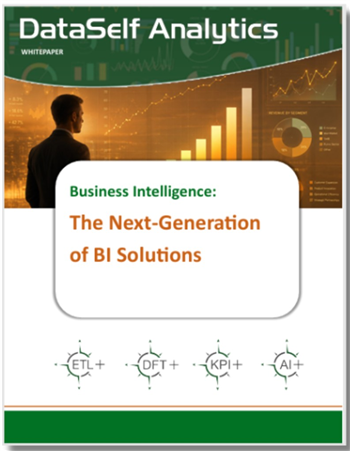
- ETL+ gets the data out of source systems and into the data warehouse.
- DFT+ models and enriches that data, turning transactional information into business-ready dimensions, facts, and time structures.
- Star and galaxy schemas organize that information so it can be queried efficiently across business functions.
- Security controls who can see what at the data warehouse level.
- Performance optimization ensures that even complex queries can return quickly.
And then the tools people already use — Power BI, Tableau, Excel, and AI platforms such as Claude, Copilot, ChatGPT, and Gemini — can work from that trusted foundation.
The result is more than simply making data available to AI.
It gives AI context.
Instead of asking an AI model to figure out what a raw database means, DataSelf gives it a business-ready structure where definitions, relationships, calculations, and security rules have already been established.
That can improve consistency, speed, security, and efficiency — and it can dramatically reduce the amount of work an AI model has to do simply to understand the data.
DFT+: From Raw Transactions to a Single Version of the Truth
At the center of this architecture is DFT+, DataSelf’s Dimension, Fact, and Time modeling layer.
This is where raw transactional data becomes business information.
- Dimensions define the things a business analyzes—customers, products, projects, accounts, locations, and more.
- Facts contain the measurable business activity—sales transactions, invoices, gross profit, inventory movements, and other events.
- Time structures provide a consistent way to analyze that activity across dates and periods.
Importantly, this isn’t simply an automated process that hands everything over to AI.
DFT+ is AI-assisted and human-curated.
AI can help accelerate the work of modeling, documenting, and transforming data, while people remain responsible for determining what the business definitions actually mean.
That distinction becomes increasingly important as AI becomes more involved in analytics.
AI can help build the model.
The business still defines the truth.
Star Schemas: Giving AI a Map of the Business
The next layer is the star schema.
A star schema organizes transactional information around the dimensions people actually use to analyze it.
For example, sales data can be structured so that analytics tools, whether AI (Claude, Copilot, Gemini, Looker, Solver) or BI (Power BI or Tableau), don’t have to figure out how to connect invoices to customers, dates, products, accounts, and other related information.
Those relationships have already been defined.
The data is effectively giving the query engine a map:
- Here’s what sales means.
- Here’s how customers relate to sales.
- Here’s how dates relate to sales.
- Here’s how to calculate the measures you care about.
That dramatically simplifies the job of the tool asking the question.
Galaxy Schemas Connect the Business
A collection of related star schemas can be combined into a galaxy schema, allowing organizations to analyze multiple areas of the business within a connected framework.
This becomes particularly powerful when questions cross traditional departmental boundaries.
For example:
Which CRM opportunities turned into sales orders, shipped successfully, were invoiced, and are now outstanding in receivables?
Without a unified data structure, answering that question may require combining information from several systems — or exporting data to Excel and stitching it together manually.
With a galaxy schema, those relationships can already exist within the data foundation.
That makes cross-functional analysis possible without forcing the reporting or AI layer to reconstruct the business every time someone asks a question.
Web-based and Agentic Data Engineering
ETL+ Web
The data foundation begins with ETL+.
ETL+ Desktop remains available, but DataSelf is moving more of the ETL experience into the browser with ETL+ Web.
The goal isn’t simply to reproduce the desktop interface online. It’s to make data integration easier to manage, automate, and eventually control through natural language.
ETL+ Web organizes the process into four primary areas:
1. Mirroring
Source data from ERP, CRM, payroll, and other systems is brought into the data warehouse.
Users can see the underlying SQL and metadata without having to dig through multiple tools.
2. Transformation
Data can be transformed using existing reimport processes as well as SQL scripts.
The addition of SQL scripting makes it possible to incorporate stored procedures and other advanced transformations directly into the ETL workflow—with AI assistance available to help create and manage the code.
3. External Objects
ETL+ can also interact with external processes and data sources, including cloud scripts, local command-line actions, Power BI refreshes, CSV workflows, and Python.
That opens the door to integrating virtually any API-accessible source.
4. Scheduling and Execution
Jobs can be scheduled on a recurring basis, steps can be reordered through drag-and-drop, and groups of tables can be managed together rather than individually.
One particularly useful addition is tagging.
Tables can be tagged according to the business function they support — such as Sales or General Ledger — making it possible to filter, manage, or refresh related groups of tables without hunting through a long list.
Because ETL+ Web runs in a browser and uses Azure Entra authentication, the experience also eliminates the need to manage traditional IP whitelisting for the application.
AI-Assisted and Agentic Data Engineering
The bigger shift isn’t simply that ETL+ is moving to the web.
It’s that AI is becoming part of the data engineering process itself.
Instead of requiring a user to navigate through every step manually, AI can increasingly help generate SQL, create transformations, work with external integrations, and manage ETL processes through natural-language instructions.
The long-term vision is a data engineering experience where users can describe what they want to accomplish rather than having to know exactly which technical steps are required to accomplish it.
That doesn’t eliminate the data engineer.
It gives the data engineer a much more powerful and agentic assistant.
Security That AI Must Not Talk Its Way Around
One of the most important aspects of the architecture is where security lives.
DataSelf uses SQL Server-based security at the data warehouse level, allowing access to be controlled down to the appropriate level of the business. This layer is AI-assisted, however, only the proper users can save security changes — therefore keeping security under strict human control.
For example, a salesperson could be restricted to seeing only the accounts they are responsible for.
Because those controls exist in the data layer itself, an AI model cannot simply be prompted to ignore them.
That’s an important distinction.
The AI doesn’t decide what a user is allowed to see. The data platform does.
This provides a much stronger foundation for AI-assisted analytics than relying on the AI model itself to enforce security.
DataSelf Works with Your AI
DataSelf’s approach is also intentionally different from building a proprietary AI chatbot and asking customers to adopt yet another AI environment.
The goal is to make your AI work with your data.
That means organizations can use the AI tools they already prefer, including Claude, Copilot, ChatGPT, Gemini, and others — to interact with their DataSelf data.
There are several advantages to this approach.
- Your existing AI environment already understands your preferences and context.
- Your prompts remain within your AI relationship rather than becoming something DataSelf needs to manage.
And DataSelf doesn’t add a markup to your AI usage. Your organization maintains its own relationship with its chosen AI provider.
Most importantly, the AI is working against a curated and governed data foundation rather than trying to interpret raw transactional data.
Fewer Tokens. Better Answers.
There is another practical advantage to giving AI a well-structured data foundation: efficiency.
When an AI model has to work with an uncurated database, it may need to inspect tables, determine relationships, identify relevant fields, interpret definitions, and figure out how calculations should be performed before it can answer the actual question.
That consumes tokens and adds opportunities for error.
With DataSelf, much of that context is already defined through metadata, DFT+ models, and star schemas.
The AI can get to the relevant data more directly.
In DataSelf’s internal testing, we were able to note reduced AI token usage by roughly 10x compared with querying an uncurated data source directly.
The broader point is even more important than the specific number:
Better data modeling doesn’t just make AI more accurate. It can make AI more efficient.
Keeping Humans in Control
As AI takes on more responsibility, governance becomes more — not less — important.
AI can produce remarkably useful results, but it WILL also make mistakes. This includes misunderstanding questions, interpreting data incorrectly, or generating an answer that sounds convincing but isn’t correct. And, as the king of the data geeks, Joni Girardi himself likes to add, “And, according to Murphy’s Law – these mistakes will happen at the worst possible time…and how will you know?”
And when an AI-generated answer causes a business problem, the responsibility ultimately belongs to the people using the system — not the AI.
That’s why DataSelf’s approach is to use AI as an assistant, not as the final authority over business governance.
- AI can accelerate modeling.
- AI can generate SQL.
- AI can help build reports.
- AI can execute ETL processes.
…But humans must remain responsible for defining business rules, determining appropriate access, and deciding what the organization considers trustworthy.
In other words, if something goes terribly wrong – there needs to be someone who can be held accountable…and you can’t fire AI. If we have a human whose livelihood is at stake – they’ll take great care to ensure that the analytics provided are in fact, correct.
What’s Next for AI-Powered Analytics?
The bigger question isn’t simply what AI can do today.
It’s, “What will AI make unnecessary tomorrow?”
As AI becomes capable of generating queries, building dashboards, managing ETL processes, and interacting directly with business data, some of the traditional layers of analytics will inevitably change.
DataSelf’s roadmap reflects that reality.
Power BI and Tableau remain important, highly capable tools...but organizations will increasingly have another option: AI-generated reporting and dashboards that can be created, modified, and maintained through natural-language interaction.
That represents a fundamentally different way of thinking about business intelligence.
Instead of asking:
“Which report should I open?”
a user can ask:
“Show me what’s driving the decline in gross margin this quarter.”
And instead of waiting for someone to build the report, the system can potentially create the analysis on demand.
That’s where the combination of a trusted data foundation and AI becomes especially powerful.
From AI-Ready Data to AI-Driven Analytics
The future of analytics isn’t simply about putting AI on top of existing BI.
It’s about building the data foundation so that AI can actually use business data intelligently.
That means:
- Connecting the data.
- Modeling the data.
- Governing the data.
- Securing the data.
- Optimizing the data.
Once all of those are complete – a company can safely allow AI to work with the data.
That’s the direction DataSelf is taking with ETL+, DFT+, galaxy schemas, AI-assisted data engineering, and AI-powered analytics.
The goal isn’t to replace trusted data with AI.
It’s to make trusted data the foundation that makes AI useful.
See It in Action
The concepts become much clearer when you see them working.
In our recent webinar, Cracking the Nut—DataSelf’s Latest and Greatest, DataSelf shows AI doing things that traditionally required a user to work directly inside the platform — including running ETL+ through a natural-language conversation and building an interactive, cross-filterable sales dashboard entirely from prompts.