
Business Intelligence for Everyone: How AI and Flexible Design Are Changing BI
From no-code simplicity to full-code customization, next-generation BI is making powerful analytics accessible to more users than ever before.
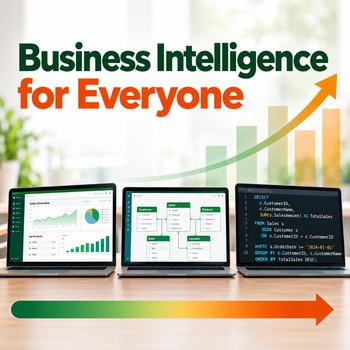 Business intelligence (BI) has come a long way. Today’s organizations have access to powerful reporting tools, sophisticated dashboards, and an abundance of data. Yet one challenge continues to stand in the way of getting the most value from these technologies: usability.
For years, implementing, customizing, and managing BI solutions has required specialized technical expertise. Even relatively simple reporting requests could involve IT resources, complex programming, or lengthy development cycles.
The result? Organizations often find themselves choosing between powerful but complicated solutions and easier-to-use tools that may lack the flexibility needed for more advanced analytics.
Fortunately, next-generation BI is changing that equation.
With AI-assisted report design and flexible development options, organizations can make business intelligence more accessible to everyone—from business users who simply need answers to experienced developers building sophisticated analytical solutions.
The Challenge: Powerful BI Hasn’t Always Been Easy to Use
Traditionally, implementing a business intelligence solution required multiple technical skills, specialized resources, and considerable time.
Whether building a dashboard, customizing reports, connecting data sources, or modifying calculations, organizations often depended on technical experts to translate business requirements into working analytical solutions.
This created several common challenges:
- Limited self-service capabilities: Business users often relied on IT or report developers to create or modify reports.
- Complex implementation: Deploying and customizing BI solutions could require significant technical knowledge.
- Increased costs: Specialized resources and lengthy development cycles added to the total cost of ownership.
- Slower decision-making: Waiting for reports or modifications could delay access to important business insights.
- Limited flexibility: Easy-to-use reporting tools sometimes lacked the advanced functionality needed for complex analytics.
The underlying problem wasn’t necessarily a lack of powerful technology. It was the difficulty of making that technology usable across an organization.
Modern BI needs to accommodate a much broader range of users, technical abilities, and business requirements.
The Solution: AI-Assisted Report Design
One of the most significant advancements in next-generation business intelligence is the growing role of artificial intelligence in report design and development.
AI is helping bridge the gap between technical complexity and business usability.
Instead of requiring users to understand every underlying data relationship, calculation, or programming language, AI-assisted tools can help streamline the process of creating and customizing analytical solutions.
For example, AI can assist with:
- Data relationships: Helping identify and establish connections between tables.
- Report development: Supporting the creation of reports, dashboards, and visualizations.
- KPI design: Assisting with the development of calculations and business performance metrics.
- Data exploration: Enabling users to ask questions in natural language.
- Customization: Helping users modify analytical solutions without requiring extensive programming knowledge.
This doesn’t eliminate the need for technical expertise. Rather, it makes that expertise more productive while allowing less-technical users to accomplish more independently.
And when AI works with a well-organized, governed data foundation, it can provide a more reliable starting point for generating meaningful business insights.
The goal is simple: Make sophisticated BI capabilities easier to access, use, and customize.
One BI Solution, Three Ways to Work: No Code, Low Code, and Full Code
Not every business user has the same technical abilities—or the same reporting requirements.
An executive reviewing financial performance may need a ready-to-use dashboard. A business analyst may want to modify KPIs or explore relationships between datasets. Meanwhile, an IT professional may need to build highly customized reports or integrate additional data sources.
A modern BI platform should support all three.
That’s where the No Code, Low Code, and Full Code approach comes in.
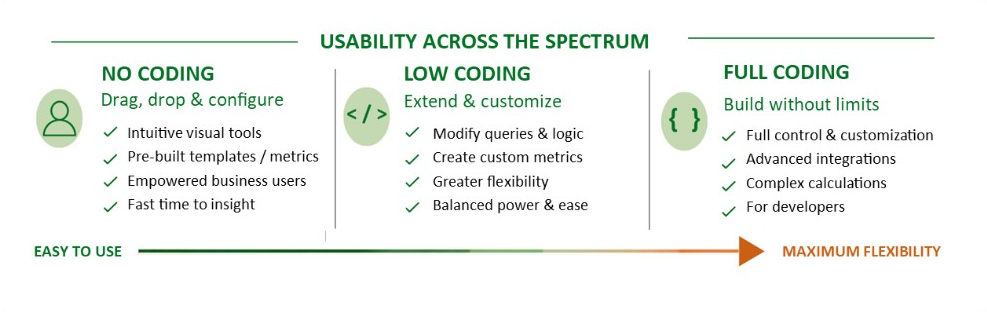
1. No Code: Business Intelligence Made Simple
No-code capabilities allow users to access and interact with business intelligence without writing programming code.
With preconfigured dashboards, intuitive interfaces, and AI-assisted analysis, users can focus on understanding their data rather than developing the technology behind it.
Common no-code capabilities include:
- Ready-to-use reports and dashboards
- Prebuilt KPIs and analytical templates
- Interactive visualizations and drill-down capabilities
- Natural-language questions and AI-assisted insights
- Simple, self-service reporting tools
Best suited for: Executives, managers, and everyday business users who want fast access to meaningful insights without technical complexity.
2. Low Code: More Flexibility, Less Complexity
Low-code capabilities offer additional flexibility for users who want to customize their analytics without taking on the full complexity of traditional programming.
Business analysts and technically inclined users can modify reports, adjust calculations, explore data relationships, and create more specialized analytical solutions.
AI-assisted tools can further simplify these tasks by helping with calculations, modeling, and report design.
Common low-code capabilities include:
- Customizing dashboards and reports
- Modifying KPIs and business calculations
- Creating additional visualizations
- Adjusting data relationships and analytical models
- Using AI assistance to streamline development
Best suited for: Business analysts, power users, and department managers who need more control over their reporting and analytics.
3. Full Code: Advanced Customization and Control
For organizations with sophisticated analytical requirements, full-code capabilities provide the flexibility to develop highly customized solutions.
Technical teams can use programming languages, advanced calculations, data integration tools, and specialized development techniques to address complex business requirements.
Rather than limiting advanced users to a rigid set of features, next-generation BI gives them the tools to extend and optimize their analytical environments.
Common full-code capabilities include:
- Advanced SQL queries and calculations
- Complex data transformations and integrations
- Custom analytical models
- Specialized reporting applications
- Advanced automation and development workflows
Best suited for: IT professionals, developers, and data specialists who require maximum flexibility and control.
Why Flexibility Matters
The real advantage of a No Code, Low Code, and Full Code approach isn’t simply offering different development methods. It’s allowing organizations to support a wide spectrum of users within a unified BI strategy.
Business users can access the information they need without becoming programmers. Analysts can customize reporting to address evolving requirements. Technical teams can build advanced solutions without being constrained by simplified interfaces.
And as employees gain experience or business requirements become more complex, they can move toward more advanced capabilities without abandoning their existing BI investment.
Modern BI should adapt to the user—not force every user to adapt to the technology.
AI Makes BI More Accessible—But Trusted Data Still Matters
AI-assisted report design represents an important advancement in usability, but there’s another critical consideration: the quality of the data behind the reports.
Making it easier to generate reports doesn’t automatically make those reports accurate.
If the underlying data contains inconsistencies, duplicate records, poorly defined relationships, or conflicting calculations, AI can inadvertently amplify those problems.
This is why a trusted data foundation is essential to next-generation BI.
A well-designed data warehouse helps organizations integrate, cleanse, standardize, and organize their information before it reaches their reporting and AI tools.
By combining a trusted data foundation with AI-assisted design, organizations can benefit from both sides of the equation:
Better data for more reliable analytics—and smarter tools that make those analytics easier to use.
How DataSelf Brings It All Together
DataSelf Analytics Plus is designed to make advanced business intelligence more accessible, flexible, and effective.
Rather than focusing solely on visualization, DataSelf addresses the foundational work behind reporting while providing capabilities that help organizations simplify and accelerate analytics.
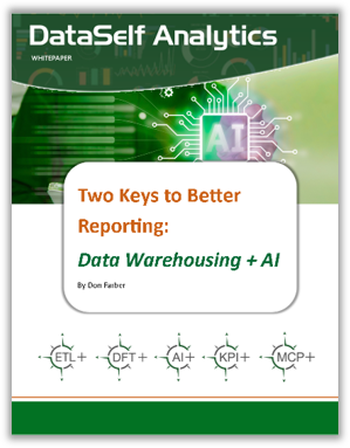
Its integrated components work together to support this approach:
- ETL+ — Data Warehousing: Integrates, cleanses, and consolidates data from multiple sources to create a trusted foundation for reporting and AI.
- DFT+ — Automated Data Modeling: Streamlines the creation of Dimension, Fact, and Time models to support consistent, reliable analytics.
- KPI+ — Ready-to-Use Analytics: Provides more than 8,000 KPIs, reports, and dashboard templates to help organizations get started quickly.
- AI+ — AI-Assisted Business Intelligence: Supports conversational analytics and assists with analytical design tasks, making sophisticated BI capabilities easier to use.
DataSelf also supports popular visualization technologies such as Power BI, Tableau, and Excel, allowing organizations to build on the tools and expertise they already have.
Whether users prefer ready-made dashboards, AI-assisted development, or advanced customization, DataSelf provides the flexibility to accommodate different technical abilities and analytical requirements.
The Future of BI Is Powerful, Flexible, and Accessible
For too long, organizations have had to compromise between ease of use and advanced analytical capabilities.
Next-generation BI is helping eliminate that trade-off.
With AI-assisted report design, flexible No Code/Low Code/Full Code capabilities, and a trusted data foundation, organizations can empower more employees to access, explore, and understand their data.
The result is a more accessible approach to business intelligence—one that helps reduce technical barriers, accelerate reporting, and make better-informed decisions possible across the organization.
Because the most powerful business intelligence isn’t just the technology with the most features. It’s the technology that empowers more people to turn data into meaningful business insights.
Ready to Make BI Easier for Everyone?
Discover how DataSelf combines trusted data warehousing, automated data modeling, ready-to-use analytics, and AI-assisted capabilities to simplify business intelligence.