
The Two Keys to Better Reporting: Trusted Data + AI
 Every organization wants better reporting.
Faster. Easier. More accurate. More secure. And, above all, more trustworthy.
With powerful Business Intelligence platforms such as Power BI and Tableau—and rapidly evolving AI tools such as ChatGPT, Claude, and Copilot—it may seem that achieving better reporting is simply a matter of choosing the right technology.
But even the best reporting or AI tool has a fundamental limitation:
It can only work with the data you give it.
If that data is fragmented, inconsistent, poorly structured, or based on conflicting business definitions, changing the tool won’t necessarily solve the problem. And adding AI doesn’t make unreliable data more trustworthy.
That leads to what we believe are the two keys to the next generation of reporting and analytics: Trusted Data + Artificial Intelligence.
Key #1: Trusted Data
Most organizations don’t have just one source of business information. Data may be spread across ERP and CRM systems, spreadsheets, cloud applications, legacy databases, and other sources.
Before that information can reliably support reporting—or AI—it needs to be brought together and prepared.
A modern data warehouse, or broader data platform, creates that foundation by integrating data from multiple sources and then cleansing, standardizing, modeling, and governing it. Centralized KPI definitions can further ensure that important business metrics mean the same thing regardless of who is viewing them or which analytics application they use.
The result is trusted, business-ready data that can support traditional reporting, dashboards, conversational analytics, and AI.
In other words, better reporting doesn’t necessarily start with a better reporting tool.
It starts with better data.
Key #2: Artificial Intelligence
AI adds an entirely new dimension to what organizations can do with that trusted data.
And its role isn’t limited to asking ChatGPT or another AI assistant a question.
Within the data environment itself, AI can help automate and accelerate processes involved in preparing, organizing, modeling, and optimizing data. On the front end, AI can provide a conversational way for users to query and analyze information without needing to know exactly where the data lives or how to write a traditional report.
Increasingly, AI is also moving beyond simply providing answers.
Agentic AI can potentially take authorized actions based on the information it analyzes.
That creates an important progression:
Find → Analyze → Understand → Act
As these capabilities develop, governance becomes even more important. Organizations need control over what information AI can access, what actions it can perform, when human approval is required, and how those activities are monitored.
Why Trusted Data + AI Are Better Together
This is where the two sides of the equation come together.
Trusted data establishes the truth. AI helps put that truth to work.
The data platform can establish consistent business meaning, definitions, relationships, security, and governance. AI can then make that information easier to access, analyze, understand, and increasingly act upon.
Together, they combine the reliability and control of governed data with the accessibility, intelligence, and automation of AI.
One Data Foundation for BI—and AI
Another important shift is that organizations no longer need to think about their data architecture as belonging to one particular reporting application.
A well-designed data platform can serve as a common foundation for Power BI, Tableau, Excel, AI applications, and whatever tools come next.
Technologies such as Model Context Protocol (MCP) can also provide a bridge between AI applications and trusted business data. This allows organizations to make governed data, business definitions, and approved capabilities available to AI without creating yet another disconnected information environment.
The reporting or AI tool may change.
The meaning of the data shouldn’t.
Preparing for What’s Next
BI and AI technologies are evolving quickly. Today’s dashboards and AI assistants are already giving way to more conversational, automated, and agentic ways of working with information.
That’s why choosing the right data platform is becoming increasingly important.
Organizations should be thinking beyond today’s reporting requirements and considering whether their data foundation can support BI, AI, APIs, MCP, governance, automation, and future agentic capabilities as their needs evolve.
The goal isn’t simply to adopt more technology.
It’s to create an environment where trusted information can move from raw data to insight—and ultimately to action.
Two Keys. One Powerful Data Strategy.
The future of reporting isn’t simply BI versus AI or one analytics tool versus another.
It is about creating a trusted data foundation and then giving people—and AI—the right tools to put that information to work.
Trusted Data + AI = Better Reporting. Smarter Decisions.
Want to Go Deeper?
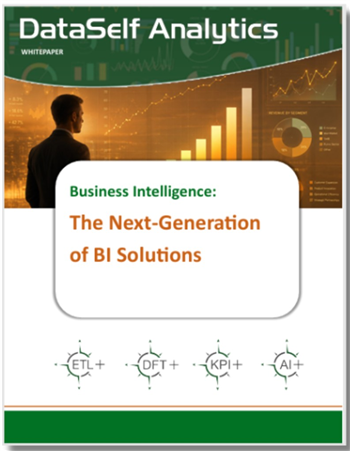
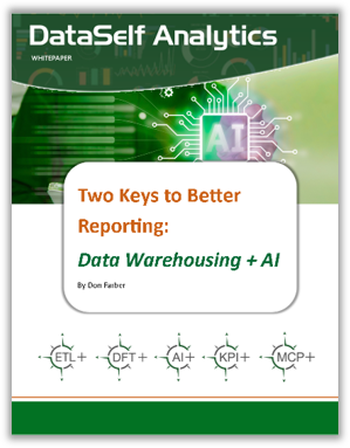
Our whitepaper, The Two Keys to Better Reporting: Trusted Data + AI, explores the complete strategy, including:
- Why reporting and AI break down
- How to build a trusted data foundation
- How AI is changing the data warehouse
- Data privacy and AI
- MCP and AI-ready data architecture
- The evolution from AI assistants to AI agents
- 12 criteria for choosing a modern data platform
- How DataSelf puts Trusted Data + AI into practice