
Deterministic vs. Statistical Reporting: Why Modern Analytics Needs Both
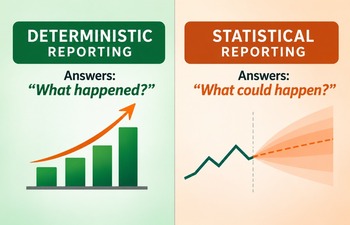 When businesses think about reporting and analytics, they tend to focus on the tools: Power BI, Tableau, Excel, AI, or whatever platform they use to turn data into answers.
But behind those tools is another important distinction that can have a major impact on the answers you receive:
Is the answer deterministic—or statistical?
Understanding the difference is becoming increasingly important as traditional Business Intelligence (BI) and artificial intelligence (AI) become more closely connected.
Deterministic Reporting: When the Answer Needs to Be Exact
Traditional BI reporting is largely deterministic.
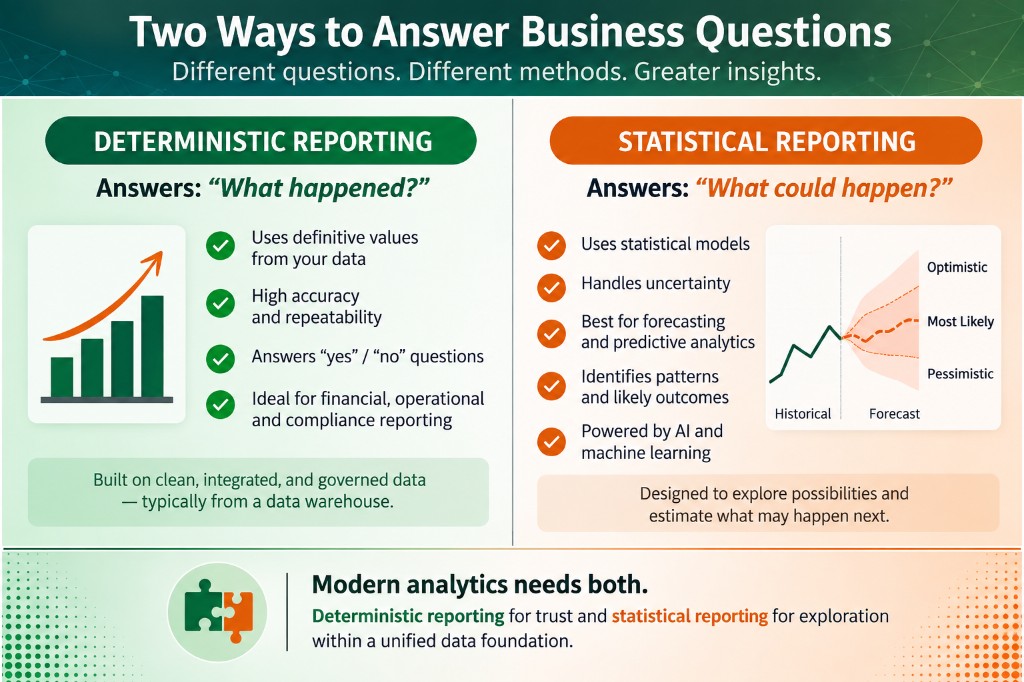
Deterministic reporting uses defined values, calculations, and business rules to produce a precise and repeatable result. Give the system the same data and the same logic, and you should get the same answer every time.
For example:
- What were total sales last quarter?
- What is our current gross margin?
- How much inventory do we have on hand?
- Which invoices are more than 60 days overdue?
- Did we meet our monthly sales target?
These aren’t questions where you want the system to give you its best guess. You need an answer based on the actual numbers.
That’s what makes deterministic reporting so valuable for financial reporting, operational analytics, compliance, KPI monitoring, and other situations where accuracy and consistency are essential.
But there’s an important catch:
A deterministic calculation is only as reliable as the data behind it.
If customer names are duplicated, product categories are inconsistent, data resides in multiple disconnected systems, or different departments define the same KPI differently, even a mathematically correct calculation can produce a misleading business result.
Why Data Warehousing Matters
This is one of the reasons deterministic BI and data warehousing have traditionally gone hand in hand.
A data warehouse brings information from ERP, CRM, financial, operational, and other systems together and prepares it specifically for reporting and analytics.
Rather than asking every reporting tool to interpret raw transactional data independently, the warehouse can cleanse, standardize, integrate, model, and govern the data first.
It can also establish common definitions for important business metrics.
- What exactly counts as “revenue”?
- When is an order considered “complete”?
- Which costs are included in gross margin?
Once those definitions are established centrally, reporting tools can work from the same trusted foundation.
The result is deterministic reporting that isn’t just mathematically precise—it is based on consistent, business-ready data.
Statistical Reporting: When There Isn’t One Definitive Answer
Statistical—or probabilistic—reporting approaches data differently.
Instead of calculating one definitive answer from established facts and rules, statistical methods analyze patterns and relationships within data to determine what is likely to be true or happen next.
That makes statistical analytics particularly useful when there is uncertainty involved.
Rather than asking:
“What were our sales last quarter?”
you might ask:
“What are our sales likely to be next quarter?”
Or:
- Which customers are most likely to churn?
- Which products are likely to experience increased demand?
- How much inventory are we likely to need next month?
- Which sales opportunities have the highest probability of closing?
- What factors are most likely contributing to a change in performance?
There may not be a single mathematically certain answer to these questions.
Instead, statistical models examine available information, identify patterns, and calculate probable outcomes.
Where AI Enters the Picture
This statistical approach is particularly important because it forms the foundation for many of today’s AI-driven analytics capabilities.
Artificial intelligence and machine learning can analyze enormous quantities of data, recognize relationships that may be difficult for humans to detect, and use those patterns to generate predictions, forecasts, classifications, and other probable results.
This opens the door to an entirely different type of business intelligence.
Traditional deterministic reporting is excellent at telling you:
What happened?
Statistical and AI-powered analytics can help explore:
What is likely to happen next?
And potentially:
What should we do about it?
That distinction helps explain why AI can add so much value to traditional BI—but also why AI shouldn’t necessarily replace it.
Deterministic vs. Statistical Isn’t an Either/Or Decision
The most powerful modern analytics environments can use both approaches together.
Imagine a sales executive reviewing the business.
Deterministic BI might tell her:
Revenue is $12.4 million year-to-date, up 7.2% from the same period last year.
Those figures are calculated from governed business data using established definitions.
AI and statistical analytics might then add:
Based on current pipeline, historical conversion rates, seasonality, and recent trends, revenue is projected to finish the year between $18.1 million and $18.8 million.
The first answer tells her what is.
The second helps estimate what may be.
Together, they provide a much more useful picture of the business.
The Better the Data, the Better Both Approaches Become
Statistical models can often work with ambiguity and incomplete information better than rigid deterministic calculations. But that doesn’t mean data quality suddenly stops mattering when AI enters the equation.
Quite the opposite.
AI can identify patterns in the information it receives—but if that information is inconsistent, poorly defined, duplicated, outdated, or missing important business context, those problems can affect the quality of its conclusions.
This is where the worlds of data warehousing, BI, and AI begin to converge.
A modern data foundation can provide clean, integrated, governed business data for traditional reporting while also giving AI access to richer and more meaningful business context.
Instead of forcing organizations to choose between the precision of BI and the possibilities of AI, they can use each for what it does best.
Trusted Facts + Intelligent Predictions
For decades, Business Intelligence has helped organizations answer questions with reliable, deterministic data.
AI expands what’s possible by adding statistical and probabilistic analysis—helping organizations forecast, identify patterns, explore possibilities, and anticipate what may happen next.
The future of analytics isn’t about choosing one approach over the other.
It’s about knowing when you need a fact, when you need a probability, and how to use both together.
And in either case, the quality of the answer ultimately depends on the quality of the data behind it.