
Do You Actually Need a Data Warehouse? In the Age of AI, the Answer May Surprise You.
AI is transforming business reporting. But without a trustworthy data foundation, even the most sophisticated AI tools can deliver misleading results.
 Businesses have more ways than ever to analyze their data. From traditional reporting tools like Excel, Power BI, and Tableau to conversational AI tools that answer questions in plain English, accessing business intelligence has never been easier.
But there’s a critical question organizations often overlook:
Is your business data actually ready to support these technologies?
For many organizations, the answer lies in something that has been around for decades but has become more important than ever: the data warehouse.
And while data warehousing isn’t new, its role has evolved dramatically. Today, a modern data warehouse does much more than store historical information. It provides the governed, curated, and consistent data foundation that enables faster reporting, more accurate analytics, and more trustworthy AI-generated insights.
10 Signs Your Business Needs a Data Warehouse
Not every organization starts out needing a sophisticated data infrastructure. But as businesses grow, so do their reporting requirements, data complexity, and analytical challenges.
If any of the following sound familiar, it’s probably time to consider a data warehouse.
1. Your reports take too long to run.
Complex reporting queries can slow down operational systems, especially when large volumes of transactional data are involved. A data warehouse moves analytical workloads into an environment optimized for reporting, enabling faster queries without interfering with daily operations.
2. You need to combine data from multiple applications.
Your business may rely on an ERP for financials, a CRM for sales, and other applications for inventory, operations, or eCommerce. A data warehouse brings information from these disconnected systems together, providing a more complete picture of business performance.
3. You need more sophisticated financial reporting.
Advanced financial analysis often requires historical comparisons, consolidated reporting, custom calculations, and consistent definitions across departments or entities. A data warehouse organizes financial information to support these requirements.
4. Different departments report conflicting numbers.
When sales, finance, and operations calculate the same KPI differently, which number is correct?
A properly modeled data warehouse establishes consistent business definitions and calculations, creating a Single Version of the Truth that everyone can rely on.
5. Your historical data is inconsistent or incomplete.
Operational systems are designed to process transactions, not necessarily preserve every historical change needed for analysis. A data warehouse can retain historical snapshots and provide a more consistent foundation for understanding trends over time.
6. You need to consolidate financial data across multiple business entities.
Businesses with multiple companies, divisions, or locations often struggle to combine financial information into meaningful consolidated reports. A data warehouse can standardize and integrate this information for enterprise-wide visibility.
7. You want to combine data from multiple business silos.
Data scattered across departments makes it difficult to understand how different areas of the business influence one another. Bringing that information together reveals relationships, trends, and opportunities that isolated reporting may miss.
8. You want to improve the performance, security, and accessibility of your data.
A modern data warehouse can provide controlled access to analytical information, reducing dependence on direct connections to transactional systems while supporting more efficient reporting and data governance.
9. You want to use AI to interact with and analyze business data.
Conversational AI makes it possible to ask questions like “Why did our margins decline last quarter?” or “Which customers are most likely to become overdue?”
But AI needs more than access to raw data. It needs reliable definitions, meaningful relationships, and appropriate context to generate trustworthy answers.
10. You need a data foundation that can support multiple BI and AI technologies.
Technology changes. Your business intelligence tools may change with it.
A well-designed data warehouse creates a reusable analytical foundation that can support Power BI, Tableau, Excel, AI assistants, and future technologies without rebuilding your entire data infrastructure every time.
Why Data Warehousing Is Even More Critical in the Age of AI
Traditionally, organizations invested in data warehouses to improve reporting performance, consolidate information, and make historical analysis easier.
Those benefits remain important. But AI has introduced an entirely new level of urgency.
AI can make accessing answers dramatically easier. It cannot automatically make those answers accurate.
Consider what happens when an AI tool is connected directly to raw ERP or CRM data.
It may encounter:
- Duplicate, missing, or inconsistent records.
- Conflicting definitions of revenue, profit, or other KPIs.
- Complex database relationships without sufficient business context.
- Transactional data that has not been validated or reconciled.
- Historical information that is incomplete or inconsistently maintained.
- Sensitive information that should not be accessible to every user.
Even a highly capable AI system can misunderstand relationships, misinterpret calculations, or generate misleading conclusions when working with poorly structured data.
And because AI can present those conclusions in confident, conversational language, incorrect answers may appear entirely credible.
The solution isn’t simply better AI. It’s better data for AI.
Governed and Curated Data: The Foundation for Trustworthy AI Reporting
Two concepts are especially important when preparing business data for AI: data governance and data curation.
Governed Data: Establishing Trust and Control
Data governance establishes the rules, definitions, responsibilities, and access controls that help ensure business information is used consistently and appropriately.
For AI reporting, this means users and AI tools should work with data that has clearly defined business meaning and appropriate security controls.
For example, when someone asks AI for “total revenue,” the system should have access to an established revenue definition rather than independently guessing which database fields and calculations to use.
Curated Data: Making Information Ready for Analysis
Data curation transforms raw transactional information into organized, meaningful, analysis-ready data.
This can include:
- Cleansing and standardizing information.
- Integrating data from multiple business applications.
- Establishing relationships between data entities.
- Organizing information into dimension, fact, and time models.
- Applying consistent KPI calculations and business logic.
- Preparing historical information for trend analysis and comparisons.
When AI works with curated data, it has a much stronger foundation for understanding what the information represents and how it should be analyzed.
Governance establishes the rules. Curation prepares the data. Together, they make AI reporting more reliable.
Neither eliminates every possibility of an AI error, but both significantly improve the conditions under which trustworthy answers can be produced.
DataSelf: Turning Raw Business Data into AI-Ready Intelligence
This is where DataSelf’s approach to data warehousing makes a difference.
Rather than treating a data warehouse as simply another place to store information, DataSelf helps organizations build a structured, governed, and curated analytical foundation designed to support traditional BI and emerging AI technologies.
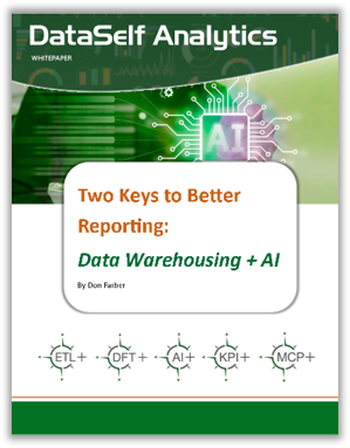
DataSelf Analytics Plus brings together four complementary capabilities:
DataSelf ETL+ — Advanced Data Warehousing
Extracts, integrates, cleanses, and organizes data from ERP, CRM, and other business applications, creating a reliable foundation for analytics.
DataSelf DFT+ — Automated Data Modeling
Transforms business information into Dimension, Fact, and Time models, helping establish the relationships and structures needed for consistent, meaningful analysis.
DataSelf KPI+ — 8,000+ Prebuilt KPIs and Analytics Templates
Accelerates reporting with thousands of ready-to-use KPIs, dashboards, and analytical best practices for finance, sales, inventory, operations, and other business functions.
DataSelf AI+ — AI-Powered Analytics
Brings AI capabilities into the analytics process, including conversational data analysis and AI-assisted development, helping organizations interact with business information more intuitively.
Together, these components help bridge the gap between complex transactional data and accessible, trustworthy business intelligence.
A Data Warehouse That Supports Your Choice of BI and AI Tools
One of DataSelf’s important advantages is its flexible architecture.
Organizations can continue using familiar reporting tools such as Power BI, Tableau, and Excel while preparing their data foundation for newer AI-driven capabilities.
Instead of relying on a particular reporting interface to define business logic independently, DataSelf helps establish that logic within the underlying analytical environment.
This means organizations can adopt new reporting and AI technologies without abandoning the trusted data foundation they’ve already built.
The Two Keys to Better Reporting: Better Data and Better Analytics
At DataSelf, we believe trustworthy reporting requires two essential elements:
Key #1: A trustworthy data foundation.
Information must be integrated, cleansed, organized, modeled, and governed before it can consistently deliver reliable business insights.
Key #2: Powerful, accessible analytics.
Once the data foundation is established, organizations can leverage their preferred BI and AI tools to explore information, uncover trends, identify anomalies, and make better-informed decisions.
The relationship between these two keys becomes especially important with AI.
AI excels at helping users explore information, recognize patterns, and ask increasingly sophisticated questions.
But the data warehouse provides the structured business context that helps keep those answers grounded in trustworthy information.
Think of it this way: Building AI reporting without a reliable data foundation is like building a house on sand.
The technology may be impressive, but the underlying structure determines how dependable the results will be.
Future-Proofing Your Analytics Investment
The business intelligence landscape will continue to evolve.
New AI assistants, reporting interfaces, and analytical capabilities will emerge. The way people interact with data may look dramatically different just a few years from now.
But one requirement isn’t going away:
Businesses will always need reliable, consistent, and well-governed data.
A modern data warehouse provides an enduring foundation that can support the reporting tools you use today and the AI innovations you’ll adopt tomorrow.
And with DataSelf’s automated data integration, modeling, and extensive KPI library, organizations can build that foundation without starting from scratch.
So, Do You Actually Need a Data Warehouse?
If your organization struggles with slow reports, disconnected applications, inconsistent numbers, complex financial reporting, or limited historical visibility, a data warehouse may already be an important missing piece.
But if you’re planning to incorporate AI into business reporting, the question becomes even more significant.
It’s no longer just about whether you need a data warehouse to improve reporting. It’s about whether your data is prepared to deliver trustworthy AI-powered insights.
Because better AI reporting doesn’t begin with a better prompt.
It begins with better data.
Ready to Build a More Trustworthy Foundation for BI and AI?
Discover how DataSelf Data Warehousing helps transform complex business information into governed, curated, AI-ready data for faster reporting, more reliable insights, and smarter decisions.