Data Warehousing Decoded, Part 2: How a Data Warehouse Gets Populated
The Missing Link
In Part I of this series on data warehousing, we discussed what a data warehouse is, why it’s needed, and how the data within it needs to be ‘modeled’ following the concepts of dimension, fact, and time (DFT). In this article we’ll discuss what aspects of raw data need to be improved, and via what means this improvement is performed.
It’s no secret that most business applications weren’t designed with analytics in mind. Whether it’s ERP, CRM, or spreadsheets, these systems store massive amounts of data, but they often lack the structure, consistency, and speed needed for efficient reporting. As businesses scale (and continuously add to their data), these issues become more pronounced.
Sadly, more data doesn’t result in better data – or better decisions. Without a data warehouse, companies typically run into the following reporting headaches:
- Too Much Data: Business apps (like ERP and CRM) quickly generate massive amounts of transactional data (think invoices & payments) as well as text-heavy content (think purchase & sales orders) that slow down reporting tools.
- Data Quality Issues: Errors, inconsistencies, and duplicated records can skew insights and undermine the reliability of reports and dashboards.
- No Strategic Metrics: Transactional databases aren’t built for analysis – they lack prebuilt metrics and KPIs and provide no easy paths to strategic insight.
The Data Warehouse
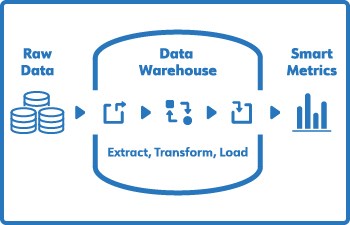 A data warehouse cleans, standardizes, and structures your data so it can deliver faster, more accurate, and more meaningful reports. How a data warehouse does this is through a process called ETL – for Extract, Transform, and Load:
- Extract data from various systems, including applications, spreadsheets, and web content.
- Transform data by cleaning it (such as removing errors & redundancies), and then create hundreds (or thousands) of KPIs and smart metrics,
- Load the transformed data into a robust, scalable SQL Server data warehouse.
Once optimized, the data becomes far more valuable – enabling quicker report creation, faster refreshes, better analytics (especially predictive analytics & forecasting), and democratized access across the business.
Without a data warehouse, reporting efforts can be slow, inconsistent, and unreliable. With a data warehouse like DataSelf ETL+™, you empower your team to create insights faster and with greater confidence, helping you shift from struggling with raw data to making smarter, more-informed business decisions.
Read Part III in this Series: The Bottom-Line Benefits of Data Warehousing