Data Warehousing Decoded, Part 3: The Bottom-Line Benefits of Data Warehousing
 In part I of this series, we defined data warehousing and how a built-in DFT layer (dimension, fact, and time) allows you to skip the “heavy lifting” of data preparation and focus on identifying and retrieving business insight.
In part II we covered how ETL technology readies your data for more informed and insightful reporting.
In this final installment we’ll discuss how these concepts and technologies work together and the bottom-line results from using them.
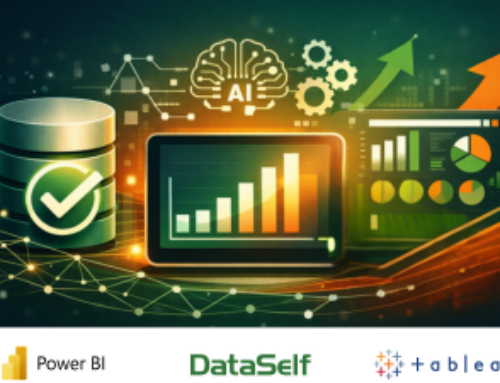
You’ve got the data – applications like ERP and CRM, countless Excel spreadsheets, and web content that grows daily. You’ve got reporting and data visualization tools like Tableau and Power BI. But without the right infrastructure to connect them, you’re likely dealing with performance issues, fragmented insights, or constant dependence on data analyst and IT resources.
You need a middle layer that bridges the gap between your raw source data and your reporting tools of choice. That middle layer is the data warehouse, and it plays a vital role in a scalable analytics solution.
As powerful as data visualization tools like Power BI, Tableau, and Excel are, they’re only as good as the source data that’s fed into them. If you connect such tools with raw source data – whether from applications or elsewhere, the results will suffer from:
- Difficult report creation (data analysts only) & slow report generation
- Incomplete insight due to data errors, inconsistencies, and few inherent metrics
- Limited ability to scale
It’s only when you pair optimized data with your preferred data visualization tools that you can build the foundation of a modern analytics ‘stack’. The data warehouse transforms your raw data and readies it for reporting and analytics. Scattered and unstructured data turns into consistent, analysis-ready fodder.
Data warehousing’s combination of DFT and ETL gives you:
- Faster report generation (due to optimized and summarized data)
- More consistent results (thanks to normalization and a single version of truth)
- More secure data (due to centralized access in the data warehouse)
- More insightful reporting (using trend analysis to generate predictive analytics)
- More agile work environment (due to the ease of building and adapting reports)
A modern reporting stack isn’t just about great data visualization tools – it’s about the quality, accessibility, and organization of the data that those tools will act on. A robust data warehouse, powered by ETL technology and automated DFT processing, ensures your insights are fast, accurate, and consistent. With DataSelf’s plug-and-play architecture, reporting and analytics are made simple, scalable, and accessible — a smart foundation for BI that turns scattered data into a strategic business advantage.